On June 1, Mayor Muriel Bowser raised the LGBTQIA+ pride flag at the John A. Wilson Building to kick off Pride Month in the District of Columbia, an annual celebration honoring the District’s lesbian, gay, bisexual, transgender, and queer residents. Capital Pride’s...
LGBTQ+ Pride Month: Ensuring Affirmative and Inclusive Whole-Person Care On June 1, Mayor Muriel Bowser raised the LGBTQIA+ pride flag at the John A. Wilson Building to kick off Pride Month in the District of Columbia, an annual celebration honoring the District’s...
Preparing for Success: Key Takeaways from DC Managed Care Readiness Workshop Uncertainty about how to get ready for integrating behavioral health into managed care led nearly 200 stakeholders to attend this event hosted by Department of Health Care Finance (DHCF), DBH...
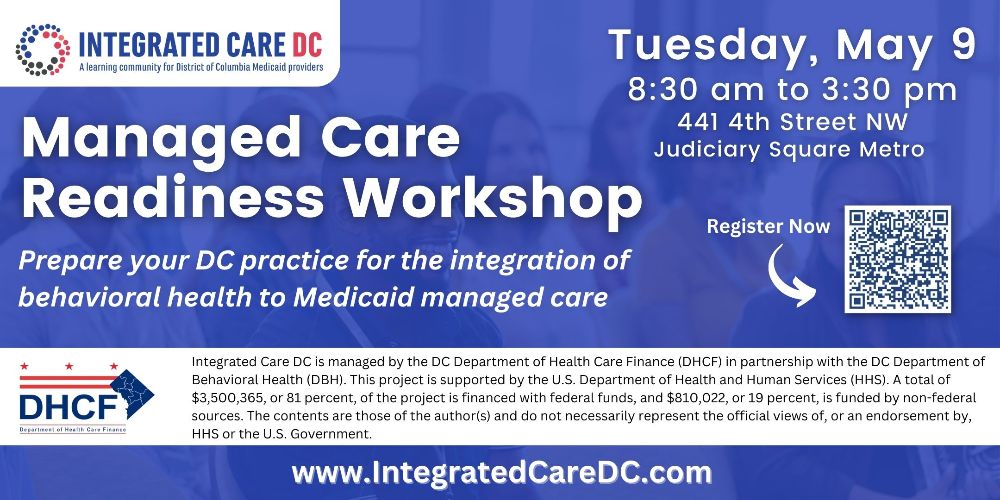
View materials from this event hosted by Department of Health Care Finance, DBH Training Institute, & Integrated Care DC on May 9, 2023. The in-person workshop was designed for behavioral health providers and other organizations seeking to prepare for the integration of behavioral health into the District’s Medicaid Managed Care Program. Presenters shared information and facilitated exercises to help leadership, clinical and operational staff, and other stakeholders develop the organizational competencies needed to succeed in managed care, including an understanding of managed care principles, how to communicate effectively with managed care partners, and how to effectively demonstrate the value of care through quality measurement and population health.
Uncertainty about how to get ready for integrating behavioral health into managed care led nearly 200 stakeholders to register for this event hosted by the Department of Health Care Finance (DHCF), DBH Training Institute, and Integrated Care DC. Barbara J. Bazron,...
The diagnosis of a long-term health condition can be frightening and overwhelming for many people. Behavioral health professionals working in integrated care settings have the unique opportunity to intervene early to assist individuals with adjusting and adapting to the new demands for behavior change that accompany a new diagnosis.
Lesbian, gay, bisexual, transgender, and questioning/queer (LGBTQ+) individuals are frequently underserved and experience significant disparities in health outcomes and accessing preventive and ongoing healthcare. Sexual and gender minorities (SGM) often experience discrimination and bias in health care settings and may delay or avoid medical and preventive care.
Developing safe, culturally competent healthcare environments and practices for LGBTQ+ patients is critical and closely related to individuals’ willingness to openly share their sexual orientation and/or gender identity and expression (SOGIE). Capturing SOGIE data is critical as it allows providers to have a more comprehensive picture of key factors that influence care.
This session will start with a brief discussion of SOGIE terminology and a compilation of what is known about medical and behavioral health needs and disparities among the LGBTQ+ community. We will highlight the critical need for creating environments that improve patients’ psychological safety and increase their willingness to share SOGIE characteristics. We will share examples of how this data could be utilized to improve care and patient satisfaction, including capturing a patient’s preferred name and pronouns, and ways to engage in respectful conversations that could reveal key aspects of their medical history that could otherwise go unnoticed.
One Week Until Integrated Care DC Managed Care Readiness Workshop We are a week away from our in-person Managed Care Readiness Workshop on Tuesday, May 9 from 8:30 am to 3:30 pm at the Marion S. Barry, Jr. Building (Metro: One Judiciary Square). Hosted by the DC...
A core skill in caring for patients in primary care is the ability to dose and titrate care for individual patients in a way that produces quality outcomes for the patient and allows a provider to care for populations of patients effectively. This session will increase the mindfulness and skills clinicians employ for dosing and titrating care from within the PCBH model.